
Wild Altars: A Pilgrimage
It begins

When I was in college, I took a class on Geoffrey Chaucer’s Canterbury Tales. For one assignment, we had to memorize the beginning of the General Prologue in its original Middle English. What remains with me after all these years is the phrase, “thanne longen folke to goon pilgrimages.”
Maybe that’s because it sums up so much of what I feel all day every day—the deepest, wildest parts of me longen to go on pilgrimages, and because of a grant from the university where I teach (College of St. Benedict/St. John’s University), I was recently lucky enough to do just that.
Merriam-Webster defines a pilgrimage as a journey of a pilgrim, and a pilgrim is one who travels to a holy place. There might be a particular destination in mind (in my case, Georgia O’Keeffe’s studio in Abiquiu, New Mexico and Bear’s Ears National Monument in Utah), and yet both pilgrim and journey are filled with just as much uncertainty as faith, just as much difficulty as hope.
A pilgrimage demands a deep listening. Where is the holy calling me next? Again and again, the pilgrim is invited to whisper yes to the mysterious, capricious energy that hides and teases, offers and frustrates.
And so, I packed my car just over a week ago. Birdie origamied her 50-pound body to fit in the tiny space behind my driver’s seat, a place that makes her feel safe. Rescued from a puppy mill, she has come such a long way. She trusts me and the world, no longer living in fear that a hand will arrive out of nowhere to pelt her like a stone.
My eight-pound Chiweenie, Alfred, proudly claimed shotgun, even though he couldn’t see out the window. He curled up, unsure if we were going to the grocery store or the moon. In his world, everything is possible.
I drove south.
South toward the prairies where I grew up. Even though I had my general itinerary in mind, I was holding this experience of wild altars lightly. I didn’t know exactly what I was doing.
And yet I had the seed of this pilgrimage planted deeply in mind.
The idea had come to me a few months earlier, and like the bible, it has two creation stories.
The first is set in Arizona. My favorite hike in Phoenix is an outer loop at Piestewa Peak. Near the end of the trail sits what I have named my wild altar. Black rocks gather like a bedlam of blades; there is no doubt about the power of this place.
And yet, this wild altar lives rooted. It is at once of the earth and wide open to the bluest, wildest skies.
Every time I hike this trail, I stop at this wild altar. I offer it some stone or piece of gnarled wood I have gathered on my way. It is my way of acknowledging its presence and power. I sit, listening to the cries of the desert and the call of energy that is beyond me.
The other impetus for this pilgrimage comes from something I’d seen online. A Zen monk had created a moveable tea room, and he would set up tatami mats and make tea in green hills or on busy streets. He would invite strangers to have tea with him—creating a holy moment in the midst of everyday life.
Combining the two, my idea was to seek and create wild altars—either to honor the ones that were already in the world, like my wild altar in Phoenix.
Or to create my own.
Where to sit? I answered that question by reaching out to a friend at Prime Avenue Farm, who raises Icelandic sheep. When I visited her farm to touch the one sheepskin she had left, I got an immediate reaction.
The soft wool under my fingers felt like Samwise Gamgee, the character I love most in Lord of the Rings. His kind and gentle presence loves and serves.
Yes. Yes.
The second thing I needed was a wild altar. I reached out to a friend who runs the Avon Hills Folk School to see if he’d be willing to make me one. When he asked what I wanted, I told him, “Surprise me.”
A couple of weeks later, he offered me four or five different possibilities. They were all stunning, but as soon as I saw her, I knew. I’d found my guide for the pilgrimage.
It might seem strange, or even affected, but I use the word her intentionally. Even Chris, the man who made her, kept referring to the wild altar as “she,” almost sheepishly, because as soon as you touch her, you know.
A discarded piece of basswood, she was not considered beautiful enough to keep . . . or work with. She’d been hacked at. Left behind.
That alone had me saying yes to her.
Then there’s the fact that she’s like the rippling muscle in a mare’s leg.
That she’s like the Mississippi . . . flat . . . soft . . . curvy . . . full of a wild, unstoppable power that can take one’s breath away.
While my yes to her was immediate and deep, I had no idea what I was getting myself into as I tucked this piece of wood behind my passenger seat and wrapped it in the sheepskin rug.
A relationship with the holy is like that.
Pointing my car’s nose toward New Mexico, I knew where my first stop had to be—the Jeffers Petroglyphs in southwestern Minnesota. I’d taken field trips there in elementary school, and as a child, I remember thinking, Why?
Why carve these things on this rock in this nowhere?
And still, I knew. I knew this vein of red rock in the green fields had been my very first wild altar. It’s where I wanted to baptize her.
Three hours later, I climbed out of my car and gasped.
Outside the fence for the petroglyphs on a bald-faced rock, I found these stones.
Waiting for me. For her.
Just as the sun was beginning to rise.
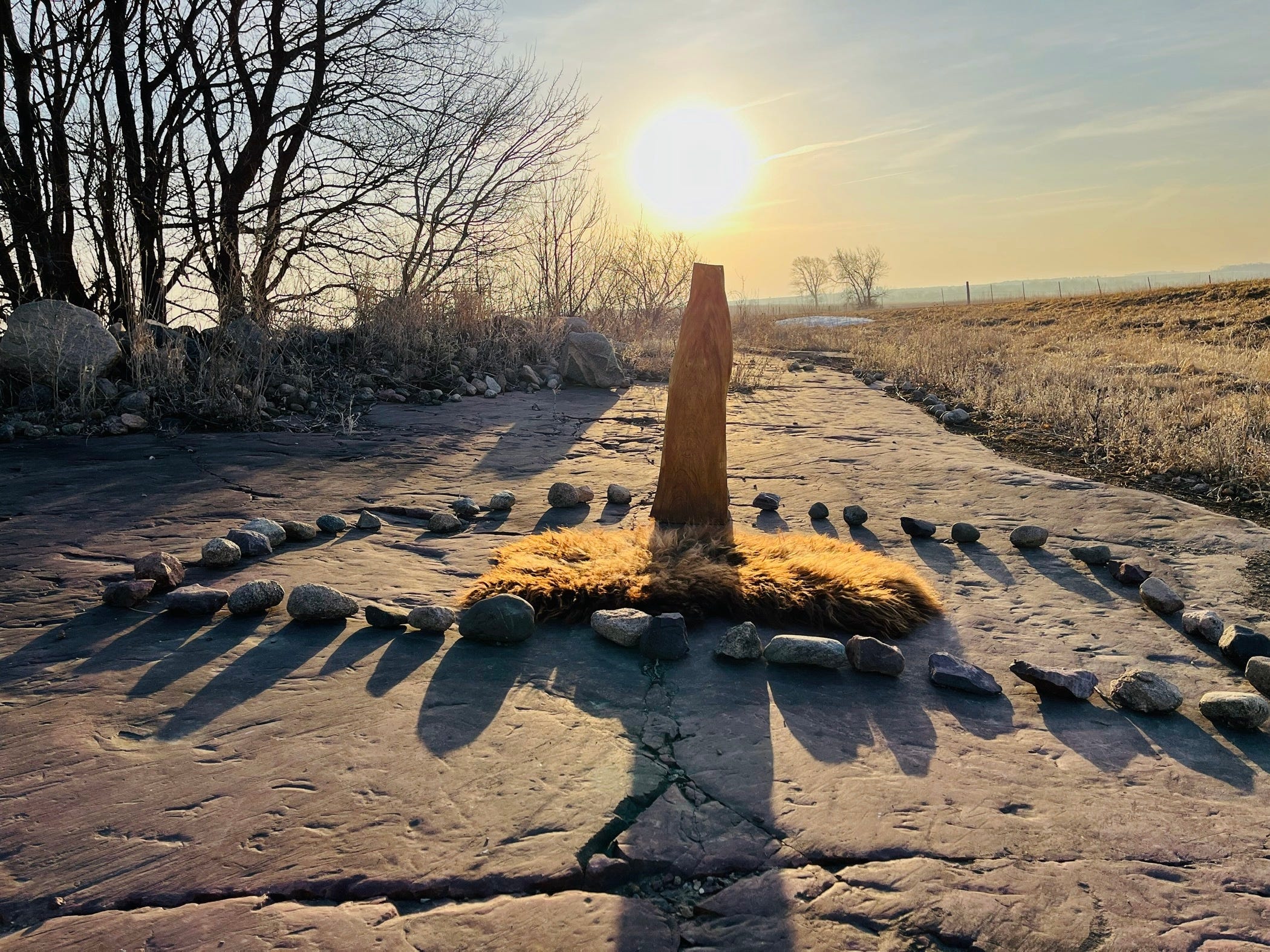
Here I am, I thought, a phrase I have always associated with saying yes to the holy.
Here I am, softening, paying attention to the gentle stirrings inside. Here I am, ready to listen, to be pulled where I would, to be a witness to the living mystery.
I stood on the rock. I kneeled on the rock, whispering, To healing. To magic. To free. To brave.
And so it begins.
This really should be a book or feature movie!
fantastic. i try to go on a pilgrimage at least once a day...🤲🏽